Research Team Composition This study brought together various experts from both domestic and international backgrounds, with team members including:
- Taipei Medical University, Graduate Institute of Injury Prevention and Control: Professor Chih-Wei Pai and Director Cheng-Yi Chen.
- National Taiwan University Hospital, Department of Traumatology: Dr Li-Min Hsu.
- Shin Kong Wu Ho-Su Memorial Hospital, Division of Trauma: Trauma Registrar Chun-Man Kuo and Director Ching-Lin Chen.
- Taipei City Hospital, Department of Critical Care Medicine: Director Zheng-Wei Zhan.
- Shuang Ho Hospital, Department of Emergency Medicine: Dr Shih-Yu Ko and Vice Superintendent Han-Ping Ma.
- Delft University of Technology (TU Delft), Netherlands: Assistant Professor Oscar Oviedo-Trespalacios.
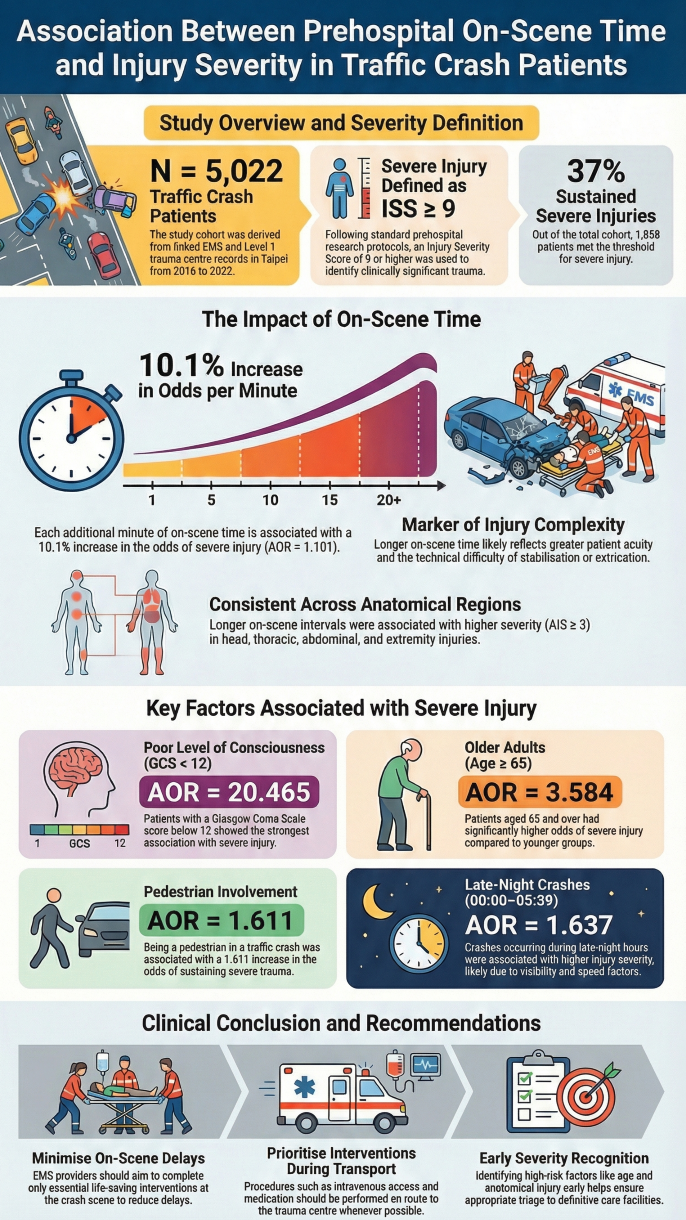
1. Positive correlation between on-scene time and injury severity: The longer ambulance personnel remain at the accident scene, the more positively correlated it is with the patient's injury severity. Overall, for each additional minute of on-scene time, the adjusted odds ratio for severe injury is approximately 1.101.
2. High-risk groups and time periods: Older adults have the highest proportion of severe injuries; accidents occurring late at night are also more likely to result in severe injuries.
3. Anatomical region-specific trauma analysis: The positive association between on-scene time and severe injury holds true for head and neck, abdominal, and extremity injuries. This correlation is particularly significant for "chest trauma in older patients," where "each additional minute of on-scene time results in an adjusted odds ratio of 1.222 for severe chest injuries".
Practical Applications and Recommendations This research indicates that "on-scene time" can serve as a vital practical warning sign to determine whether a patient is facing "complex injuries and critical conditions," helping clinical and ambulance personnel identify high-risk cases early on. The team recommends that the prehospital care system should strengthen early risk assessment and appropriate triage for transport, while minimising avoidable on-scene delays. This will assist in transporting patients more swiftly to a Level 1 trauma centre equipped with definitive treatment capabilities, thereby improving survival rates and prognoses.
Please see the full open-access paper here: https://doi.org/10.1016/j.aap.2026.108446